
This page attends to themes running through both Walker’s Appeal and Garnet’s “Address,” placing them in conversation with each other even as Garnet purposefully indicated this by choosing to publish his “Address” with Walker’s Appeal. Analysis of the similarities in their language reveals that these works are more than ‘in conversation’ with each other—Garnet is using the themes already put out in Walker’s polemic.
As discussed in other parts of this exhibit, Garnet’s address emerged in conversation with contentious precepts about the rights of African Americans being discussed at state level conventions. However, Garnet combined this discourse around secular rights with a narrative of Christian duty that comes straight from Walker’s Appeal.
Analyzing Walker’s Appeal
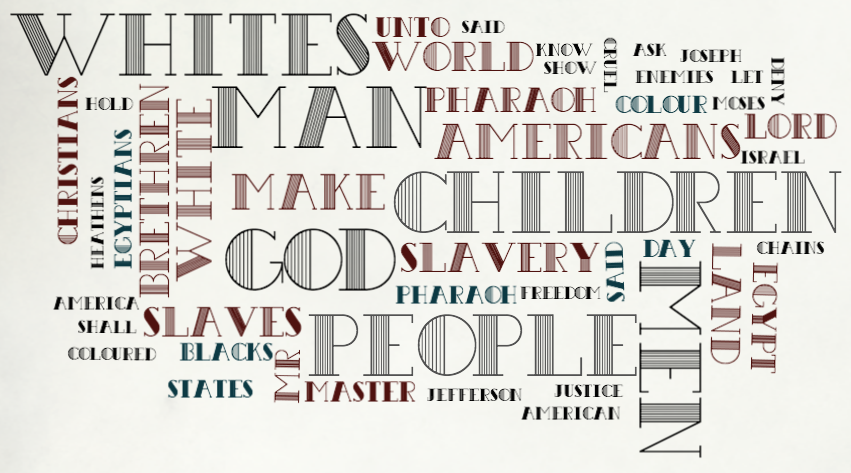
The word cloud on the right reveals the most common terms that Walker used in his Appeal. The word “God” appeared twenty times in article one of the Appeal, and Walker was adamant that God was on the side of justice:
Fear not the number and education of our enemies, against whom we shall have to contend for our lawful right; guaranteed to us by our maker; for why should we be afraid, when God is, and will continue, (if we continue humber) to be on our side?
He is likewise insistent on the duty of men to fight for their God-given rights:
The man who would not fight under our Lord and Master Jesus Christ, in the glorious and heavenly cause of freedom and of God… ought to be kept with all of his children or family, in slavery, or in chains, to be butchered by his cruel enemies.
The other most commonly appearing words in the Appeal are:
- people (x 26)
- children (x 21)
- man (x 19)
- whites (x 19)
Examining Garnet’s Address
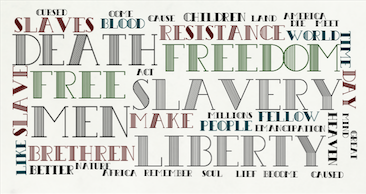
Garnet was similarly interested in the will of God, which appeared seventeen times in his address. Like Walker, Garnet argued that slavery was opposed to the tenets of divine law:
He who brings his fellow down so low, as to make him contented with a condition of slavery, commits the highest crime against God and man. TO SUCH DEGRADATION IT IS SINFUL IN THE EXTREME FOR YOU TO MAKE VOLUNTARY SUBMISSION. The divine commandments, you are duty bound to reverence and obey.
The other most commonly appearing words in the “Address” are:
- slavery (x 19)
- men (x 16)
- liberty (x 11)
- death (x 9)
Credits
Written by Jake Alspaugh, graduate student of English, University of Delaware.


