
David and Eliza Johnson, like the Gardiners, advertised heavily in 1828. The Johnsons ran their boarding house before the Gardiners moved to Elizabeth St. In their ads, they specifically point out that they serve oysters to attract patrons. The Johnsons also agreed to sell tickets to Whipper’s Reading Room address at Wesley Church in 1828. Their boarding house might have served as a cheaper alternative since the Johnsons had more residents.
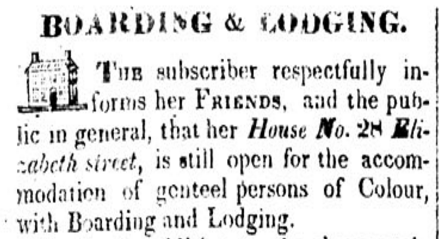
“Boarding & Lodging.” Freedom’s Journal, 24 June 1828. From Accessible Archives © 2016 Accessible Archives Inc.
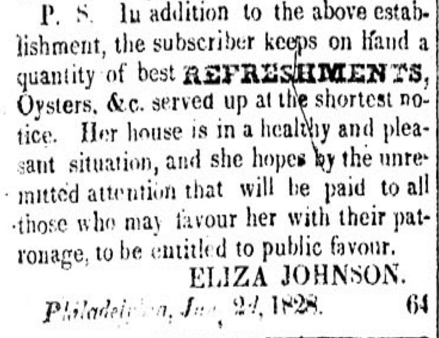
“Boarding & Lodging.” Freedom’s Journal, 24 June 1828. From Accessible Archives © 2016 Accessible Archives Inc.
It is not only the Colored Conventions delegates who took advantage of this. African American men and women who were overrepresented at the lower socio-economic strata needed affordable homes. In particular, for women who scraped by as domestic workers, affordable boarding homes were extremely necessary. In the late 1830s, a washer named K. Jackson1 and woman named Catherine Wright2 lived with the Johnsons.
Sources
- McElroy’s Philadelphia City Directory. (Philadelphia: Isaac Ashmead and Co., 1839), archive.org.
- McElroy’s, 1840.


