
Although neglected in the official convention Minutes, women participated both directly and indirectly in the 1858 convention in Cincinnati. Women were interested and actively involved in the politics of the convention, which would not have been the same without their contributions.
The most direct example of women’s involvement is the convention’s sole woman delegate, Frances Ellen Watkins [Harper]. Watkins requested to be a delegate, advocating for herself and becoming an integral part of the proceedings. The official convention minutes minimize her role, only acknowledging her when absolutely necessary. For example, in the discussion on emigration, two different newspapers note Watkins as one of the primary speakers, but the convention minutes only note the opinions of the male speakers in that discussion. The 1858 convention was likely the first time Watkins served as a delegate, but it was not the last. She would go on to address other conventions like the 1864 convention in Syracuse.
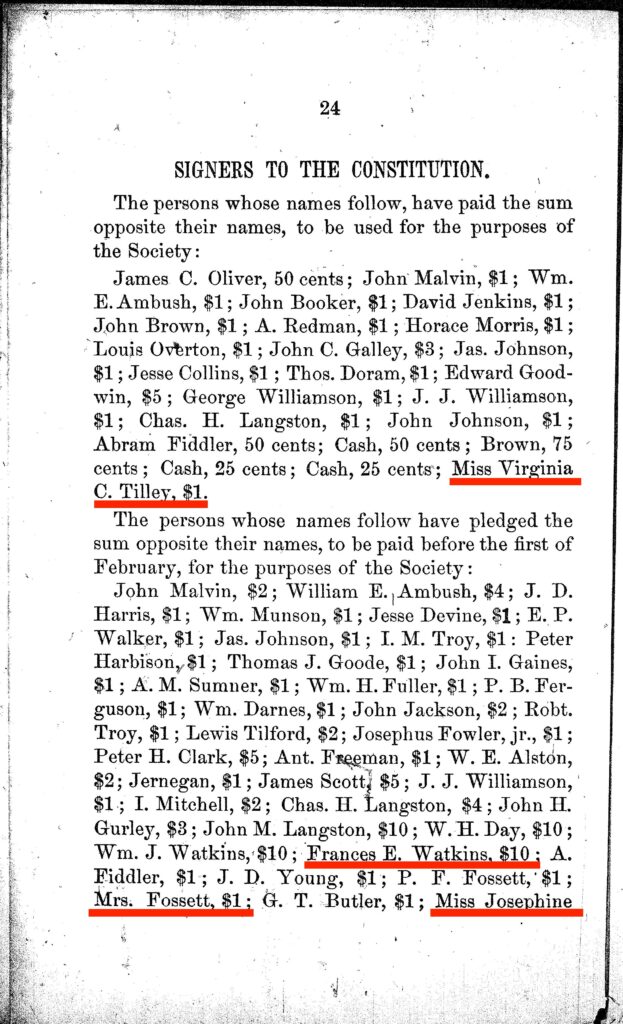
Although Harper was the only woman delegate, she was not the only woman whose name made it into the convention minutes. We can see evidence of the women who attended and impacted the convention in the list of contributors to the Ohio State Anti-Slavery Society formed at the convention:
- Miss Virginia C. Tilley, $1; Tilley taught at the Western District Male school with Peter Clark.
- Frances E. Watkins, $10
- A rather large sum of money at the time, $10 was the largest amount pledged or donated by any individual. Watkins was matched in her generosity only by John M. Langston, William H. Day, and William J. Watkins (her cousin).
- Mrs. Fosset, $1
- Miss Josephine Darnes, $1
- Mrs. Mary Anne Aray, $1; Aray taught at Eastern District school for about 6 months in 1858.
- Mrs. Eveline Cooper, $1
- Miss Amelia Williams, $1
- Miss Josephine Turner, $1
- Mrs. Mary Gibson, $1
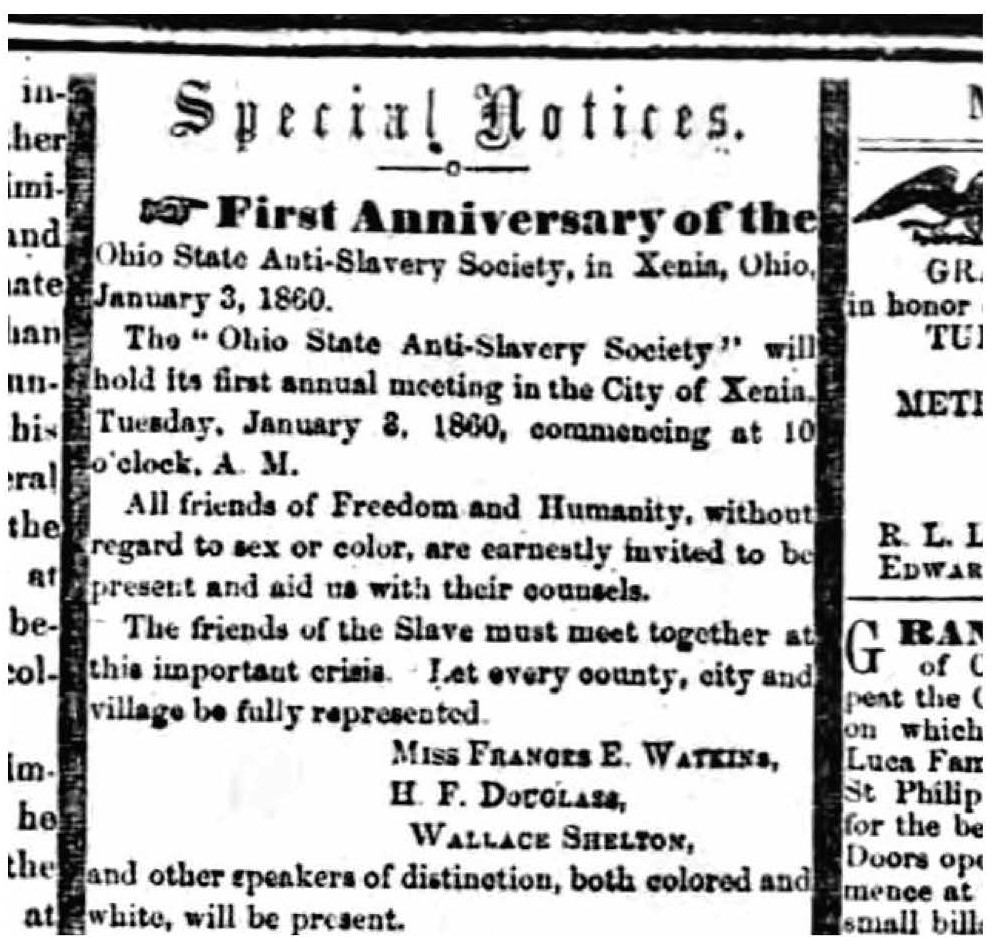
In addition to cash contributions, Mrs. A. E. Lewis and Jane Jackson volunteered to hold a fair to raise money for the Society. Frances Ellen Watkins also joined a committee committed to raising five hundred dollars for the Society. Miss Frances E. Watkins was listed with H. F. Douglass and Wallace Shelton as a “speaker of distinction” in a notice advertising the First Anniversary of the Ohio Anti-Slavery Society. Women were essential in running and financially supporting the Ohio State Anti-Slavery Society.
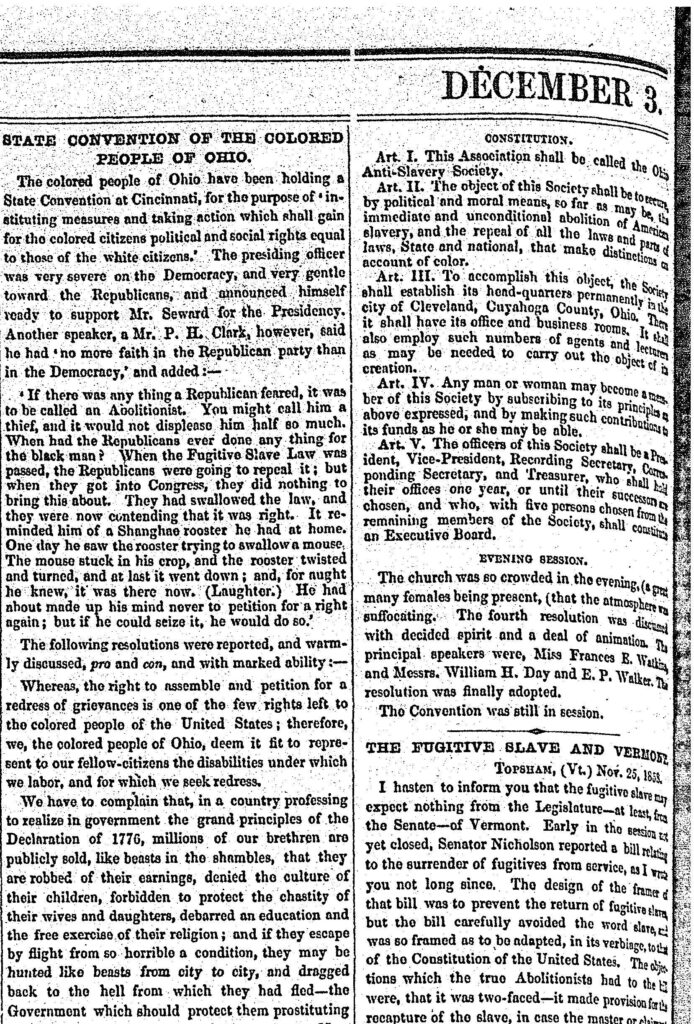
There were also many women who attended the convention who were not acknowledged in the official Minutes at all. We are able to glimpse them through other contemporary sources. The Liberator reported women’s contributions to the convention that were overlooked in the official minutes. It reported that the Wednesday evening session of the convention was stiflingly crowded because of “a great many females being present.” This single line tells us that the women of Cincinnati’s Black community were engaged in politics, watching the proceedings of the convention carefully, and asserting their investment in the result through their physical presence.
Finally, we can see women’s influence on the 1858 convention by taking a broader look at the context in which it took place. Women were active and integral members of Cincinnati’s African American and abolitionist communities. They participated economically (Catherine Doram, Eliza Potter, Elizabeth Clarke Gaines). They emancipated themselves and their families in a variety of ways (Catherine Doram, Elizabeth Clarke Gaines, Margaret Garner). They were pillars of social institutions (Catherine Doram, Francis Ellen Watkins). They led political families (Elizabeth Clarke Gaines, Consuelo Clark Stewart). Several of them achieved tremendous personal and professional success (Eliza Potter, Francis Ellen Watkins, Consuelo Clark Stewart).
Credits
Written by Nancy Yerian, Independent Historian.


