
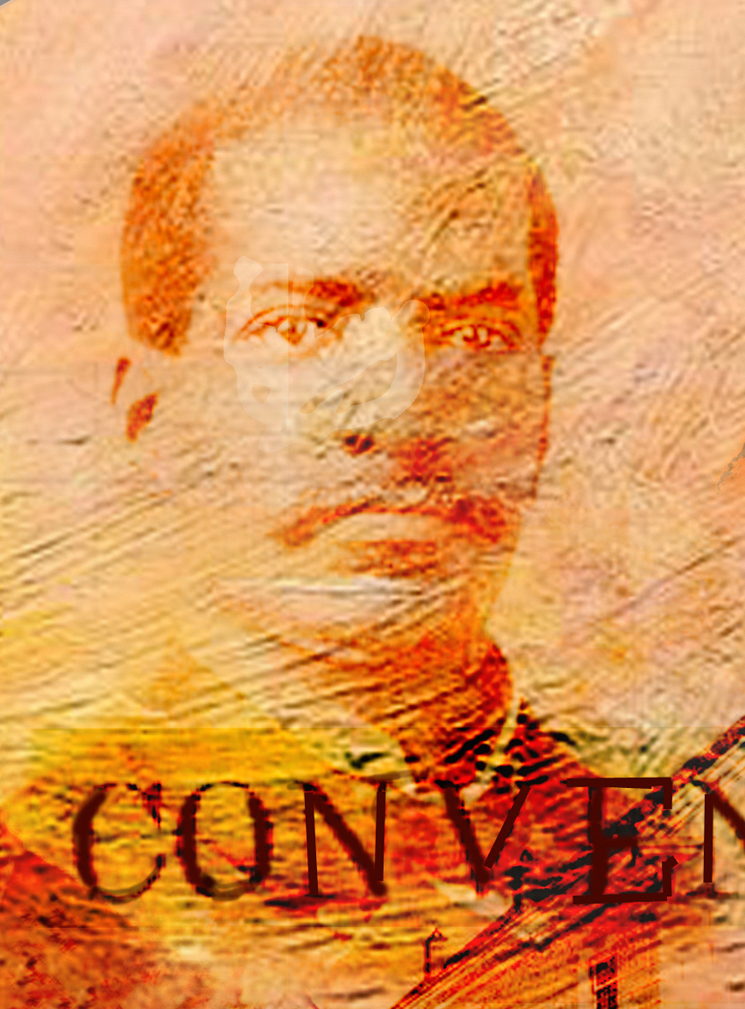
John B. Vashon (1792-1853) was a seaman, businessman, and anti-slavery activist from Pittsburgh, Pennsylvania. He was born in Virginia to an enslaved woman named Fanny and her enslaver. As a young man, Vashon served as a soldier in the War of 1812 and built a life in Pittsburgh as an owner of a bathhouse, barbershop, livery stable, and a perfumery. Vashon was known to be a “very respectable, intelligent, and industrious colored man.”[1]
In spite of this—or perhaps because of this—Vashon’s businesses became targets of racist attacks. In 1835, a mob of reportedly two to three hundred people attacked his barber shop and threatened to do it again upon being dispersed.[2]
Four years later, his perfumery caught fire. As a conductor of the Underground Railroad, Vashon worked alongside Martin R. Delaney, whom he mentored and whose education he highly encouraged. Helping freedom seekers was not always a clandestine affair, as Vashon realized. Sometime in 1849, Vashon took in “as an apprentice a bright mulatto boy of 14 years of age.”[3]
An enslaver soon recognized the boy, and Vashon was compelled to buy his freedom. Vashon also established the Pittsburgh African Education Society, an organization that sought to address the “present degradation and bondage of the people of color in these United States”; the Society also publicly declared “that the intellectual capacity of the black man is equal to that of the white, and that he is equally susceptible of improvement.”[4]
Vashon’s dedication to education was well known to many. William Cooper Nell and Harriet Beecher Stowe described Vashon as “zealous in promoting the education of his children.”[5] Vashon’s daughter Mary Frances Vashon attended Sarah M. Douglass’s academy. Mary Frances followed her parents’ footsteps, assisting freedom seekers. She also wrote pieces for Frederick Douglass’ Paper under the pseudonym Fanny Homewood. Vashon’s children and descendants shared his commitment to education, becoming educators, and activists.
Vashon was active in early Colored Conventions. In 1831, Vashon traveled to Philadelphia from Pittsburgh to attend the First Annual Convention of the People of Colour. He was also a delegate at the Second Annual Convention for the Improvement of the Free People of Color in these United States in 1832. There, Vashon asked delegates to include Andrew Jackson’s 1814 proclamation to free men of color in Louisiana in the minutes. Jackson, then serving as Major General of the U.S. Army, asked free Black men to enlist “as sons of freedom” to fight in the “present contest with Great Britain.”[6]
Vashon’s “motion provoked considerable debate and was eventually negatived,” likely due to the explicit exclusion of enslaved men in the proclamation, as well as the fact that Jackson was an enslaver of hundreds of men, women, and children.[7] Vashon’s military experience might have compelled him to put forth this motion. Vashon was not able to attend the following two Colored Conventions but sent monetary donations and letters that were read during the proceedings. Vashon and his peers organized a convention in Pittsburgh in 1841, where he served as Vice President and sat in committees responsible for drafting an address to Black Pennsylvanians and publishing the convention minutes.
Vashon attended a couple more conventions before his death, and his son, poet, educator, and lawyer George B. Vashon followed suit.[8] At the 1853 National Convention in Rochester, New York, George B. Vashon served in a committee responsible for planning the establishment of a manual labor college. He also attended the National Convention of Colored Men, held in Syracuse, New York, in 1864, immortalizing his experience of traveling to the convention in his poem, “In the Cars.”[9]
George Boyer Vashon married fellow activist and teacher Susan Paul Smith. The couple eventually moved to Missouri, where Susan became active in the Black women’s club movement, serving as the president of the Missouri State Federation of Colored Women’s Clubs of the National Association of the Colored Women’s Clubs (NACW).[10] The couple raised their children to be educators as well.[11]
Credits
Written by Samantha de Vera.
References
- “George Vashon.” The Pittsburgh Gazette, January 17, 1848, p. 2.
- “Pittsburgh, Pa. August 22, 1835.” The People’s Press, 11 September 1835, p. 2.
- “Purchase of a Slave in Pittsburgh.” Pittsburgh Daily Post, January 15, 1851.
- “African Education Society.” Pittsburgh Weekly Gazette, February 10, 1832. p.3.
- Nell, William Cooper and Harriet Beecher Stowe. The Colored Patriots of the American Revolution. Robert F. Wallcut, 1855, p. 187.
- Jackson, Andrew. “To the Free Colored Inhabitants of Louisiana.” Niles’ Weekly Register, 3 December 1814.
- Convention for the Improvement of the Free People of Color, Second Annual (1832 : Philadelphia, PA), “Minutes and Proceedings of the Second Annual Convention for the Improvement of the Free People of Color in these United States, held by adjournments in the city of Philadelphia, from the 4th to the 13th of June, inclusive, 1832.,” Colored Conventions Project Digital Records, accessed September 5, 2022.
- In particular, George Boyer Vashon was a delegate at the National Convention of Colored Citizens held in Buffalo, New York, in 1843 and the State Convention of Colored Citizens of Pennsylvania in 1848.
- Gardner, Eric, et al. “From the Periodical Archives: George Boyer Vashon’s ‘In the Cars’: A Poem and Four Responses.” American Periodicals, vol. 25, no. 2, 2015, pp. 177–87. JSTOR, http://www.jstor.org/stable/24589086. Accessed 5 Sep. 2022.
- Dowden-White, Priscilla A. Groping Toward Democracy: African American Social Welfare Reform in St. Louis, 1910-1949. University of Missouri Press, 2011, p. 35.
- Susan Paul Smith Vashon and George B. Vashon’s children Emma, John Boyer, and Frank were teachers, and John Boyer became a school principal like his father. See Dowden-White, p. 35-36.


